Book
“As [Myriam] Renaud indicates at the opening of her book, what animates her research is the question: ‘how may one construct a concept of God such that this concept is personally meaningful and validly moral?’… Theologians, seminary students, educators, clergy, study groups, and anyone interested in delving rigorously into reasoning about God in our pluralist and multireligious context will appreciate the book…”
Andrea Vicini, S.J., Boston College
“This insightful book, with in-depth methodological analyses as well as clear definitions of terms, not only makes a compelling argument but would also facilitate fruitful discussion among students and scholars of all levels.”

Constructing Moral Concepts of God in a Global Age (pub. 2023) starts with this question: If God is an idea, what ideas of God count as moral? The book focuses on what people say and think about God, rather than on whether God exists. It advances a theological method, or step-by-step approach, for individuals (or groups) to explore and reframe their understandings of God. Since a moral God is more likely to foster a moral life, the proposed method integrates an ethical check to ensure that any idea of God and the worldviews shaped by that God are validly moral.
The book's method builds on the work of twentieth-century theologian Gordon Kaufman during his Kantian, or God as an imaginative idea phase. The method is designed to accommodate the construction of a person-like idea of God who hears prayers, loves without end, and comforts in times of hardship. Given today’s pluralistic world, the ethical check integrated into the method is the Parliament of the World’s Religions “Declaration Towards a Global Ethic,” a global ethic that emerged from a widely collaborative effort and has been endorsed by thousands.
This volume of constructive philosophical theology is written for seminary students, educators, clergy, study groups, and anyone interested in delving more deeply and systematically into their ideas of God, whether their own or those of others.
#block-yui_3_17_2_1_1793383692999_7594 { --opacity: 100%; --translate-x: 0px; --translate-y: 0px; --rotation: 0deg; --scale-x: 100%; --scale-y: 100%; --skew-x: 0deg; --skew-y: 0deg; --origin-x: 50%; --origin-y: 50%; --block-transform: none; opacity: var(--opacity, 1); transform: var(--block-transform); transform-origin: var(--origin-x) var(--origin-y); }
Edited Books
co-edited with William Schweiker
“What can the religions contribute to the furthering of a Global Ethic...? This timely book grapples with my question and offers exciting answers. It also models engagement between the religions, highlighting the differences and nuances between them while also underscoring their desire for peace...”
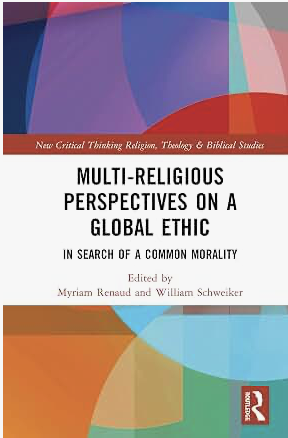
Ratified by the Parliament of the World’s Religions in 1993 and expanded in 2018, “Towards a Global Ethic (An Initial Declaration),” or the Global Ethic, expresses the minimal set of principles shared by people—religious or not. Though it is a secular document, the Global Ethic emerged after months of collaborative, interreligious dialogue dedicated to identifying a common ethical framework. This volume tests and contests the claim that the Global Ethic’s ethical directives can be found in the world’s religious, spiritual, and cultural traditions.
The book features essays by scholars of religion who grapple with the practical implications of the Global Ethic’s directives when applied to issues like women’s rights, displaced peoples, income and wealth inequality, India’s caste system, and more. The scholars explore their respective religious traditions’ ethical response to one or more of these issues and compares them to the ethical response elaborated by the Global Ethic. The traditions included are Hinduism, Engaged Buddhism, Shi‘i Islam, Sunni Islam, Confucianism, Protestantism, Catholicism, Judaism, Indigenous African Religions, and Human Rights. To highlight the complexities within traditions, most essays are followed by a brief response by an expert in the same tradition.
Multi-Religious Perspectives on a Global Ethic is of special interest to advanced students and scholars whose work focuses on the religious traditions listed above, on comparative religion, religious ethics, comparative ethics, and common morality.
Myriam Renaud and William Schweiker Introduction
Richard B. Miller Preliminaries: ground rules for grappling with the Global Ethic
Hsiao-Lan Hu Networking as equals? engaged Buddhists’ egalitarian ideals and hierarchical habits
Paul Copp Response: interrelation as if we really meant it
Samaneh Oladi Women’s religious authority in the Shi’i tradition: a quest for justice
Alireza Doostdar Response: moral authority, epistemic authority, and gender justice
Huaiyu Wang Gu Hongming and the religion of good citizenship
Brook A. Ziporyn Response to Huaiyu Wang
Amanda Beckenstein Mbuvi Avadim hayinu: an intersectional Jewish perspective on the Global Ethic of solidarity
David N. Gottlieb Response: solidarity and the sea of reeds
Anantanand Rambachan Are there principles in the Hindu tradition consonant with “freedom, dignity, and equality”?
Anand Venkatkrishnan Response: human flourishing and the anti-human
Scott A. Paeth Globalization, global ethics, and the common good: economic justice and Protestant prophetic proclamation
Kristine A. Culp Response: the ability of these simple structures to resist being defiled
Martin Nguyen Sunni Islam and the estranged idea: the displaced, the racially disenfranchised, and the Islamic prophetic
Franklin Lewis Response to Martin Nguyen
Hille Haker Decolonizing religion(s)—a new, Catholic direction for the Global Ethic
Richard B. Miller Response: on political theology and the Global Ethic
Teresia Mbari Hinga Tapping the moral wisdom of Africa’s Triple Plus heritage
Ralph A. Austen Response to Teresia Mbari Hinga
Sumner A. Twiss Reflections on the relationship between human rights and global ethics
Myriam Renaud Postscript: the Global Ethic’s Directive to care for the Earth
“If the world will ever truly become what it was created or evolved to be, we need a Global Ethic. And this creative, critical, and collaborative book pioneers the way. Celebrating particularity as it validates our common humanity. And that’s the best ethic of all.” — Dwight N. Hopkins, University of Chicago
“Multi-Religious Perspectives... is an important and well-timed book for scholars and religious leaders that both celebrates and interrogates the Parliament of the World’s Religions’ Global Ethic. It is timely, as we confront our current global crisis, that scholars provide critical perspectives on the necessity of religion to speak to larger queries of ethics and morality.” — Rosalyn LaPier, University of Illinois
“The Global Ethic is a remarkable collaborative effort... This volume’s outstanding contributors compare their respective religious traditions’ ethical thinking to the Global Ethic’s principles, offering nuanced explorations of their traditions and evaluating the consequences of the Global Ethic’s principles on key issues like women’s rights and economic justice.” — Purushottama Bilimoria, University of Melbourne
co-edited with Joshua Daniel

How do various concepts of God impact the moral life? Is God ultimately required for goodness? In this edited collection, an international panel of contemporary philosophers and theologians offer new avenues of exploration from a theist perspective for these important questions.
The book features several approaches to address these questions. Common themes include philosophical and theological conceptions of God with reference to human morality, particular Trinitarian accounts of God and the resultant ethical implications, and how communities are shaped, promoted, and transformed by accounts of God.
Bringing together philosophical and theological insights on the relationship between God and our moral lives, this book will be of keen interest to scholars of the philosophy of religion, particularly those looking at ethics, social justice and morality.
Myriam Renaud and Joshua Daniel Introduction: God and the moral life
John Hare Three arguments for the dependence of morality upon religion
Myriam Renaud Moral concepts of God in an age of globalization and contingency
William Schweiker God and the human good
Pamela Sue Anderson Ethical reflection on ‘God’: making sense of things
Mayra Rivera Emptying God: the ethics of theology in Merleau-Ponty’s work
Aristotle Papanikolaou Trinity, virtue, and violence
David Tracy God as infinite: ethical implications
Michael Fishbane Plumblines in the vastness: measures without measure
Marilyn McCord Adams Mascot or judge: God and the mores of church and society
Other Writings
“Myths Debunked: Why Did White Evangelical Christians Vote for Trump?”
Edited by Brett Colasacco · Eerdmans
Read the chapter →
“Gordon Kaufman”
Edited by Christine Helmer et al. · Berlin: DeGruyter Publishing
Read the chapter →
“In Conversation with Ken Estey’s Labor Evangelicals: Faith, Authority, and Resistance at Work”
Under review
“A Constructive, Christian, Ethical Response to AI and Brain Computer Interfaces like Neuralink’s”
Read the article →“Life-Extension Technologies and Pregnancy: Practical and Theological Considerations”
Read the article →
“The Ethics of Radical Life Extension: Perspectives from the Protestant, Roman Catholic, Orthodox Christian, and the Global Ethic Traditions”
Co-authored with William Schweiker, Hille Haker, and Perry Hamalis
Read the article →
“Call for a Theology of Theologies to Address Increasing Income Inequality in Mainline Protestant Congregations”
Read the article →

Review of Why Religious Freedom Matters for Democracy: Comparative Reflections from Britain and France for a Democratic ‘Vivre Ensemble’
Myriam Hunter-Henin (New York: Hart, 2020) · pages 530–532
Read the review →
Review of Seeing the Myth in Human Rights
Jenna Reinbold (Philadelphia: University of Pennsylvania, 2017) · pages 577–579
Read the review →Review of Comparative Religious Ethics: Everyday Decisions for Our Everyday Lives
Christine Gudorf (Minneapolis, MN: Fortress Press, 2013) · pages 223–225
Read the review →
Review of In Face of Reality: The Constructive Theology of Gordon D. Kaufman
James Thomas (Eugene, OR: Pickwick Publications, 2011) · pages 79–82
Read the review →Review of Scattering the Seed: A Guide through Balthasar’s Early Writings on Philosophy and the Arts
Aidan Nichols (London: T&T Clark International, 2006) · pages 516–517
Read the review →